Emma Harris (1871-c.1940)
Along Georgia's Savannah River, October 7th, 1871, Emma Elizabeth Matthews was born to poor Negro family in the bustling southern city of Augusta. Upon the end of the Civil War in 1865, her parents Sarah Green and Richard Matthews left the Phinizy plantation to seek a better life and opportunities in the city. Sarah worked as a washerwoman, scrubbing the clothes for the local white families while Richard laboured daily in one of the city's numerous cotton processing mills. No sooner was Emma born, two more children followed (Thomas - 1873 and Josephine - 1880) whom served as her playmates as well as aided her with the household chores.
By 1880, the family had settled in an old brick tenement on the grimy narrow 319 Houston Street. Soon after, Emma began attending, Edmund Asa Ware High School, the first public high school for Negroes in Georgia. That summer, Emma was sent to Norfolk, Virginia to live with her widowed Aunt Hattie Matthews to continue her studies and later attend the Negro Mission College (which opened 1883). But after a few years, her Aunt suddenly died, leaving the young Emma stranded in Virginia with no place to go. Instead of returning home, Emma caught the next train north, enrolling herself into the Boston Musical Conservatory and finding work as a chambermaid to support herself. Around 1892, she made her way to New York City. On December 23rd, 1896, Emma met and married local janitor, Joseph B. Harris. The couple settled into a small apartment in Brooklyn, where they hoped to start a family. She also assisted in bringing several of her relatives up from the South. After the sudden death of their only child, Emma began focusing on her singing career. Due to her staunchly religious parents' disapproval of her career as an entertainer, Emma began singing in the Trinity Baptist Church Choir and working as a domestic for nearly five years.
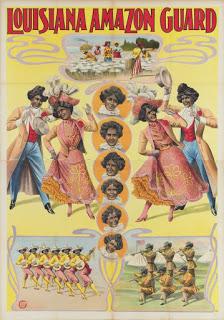
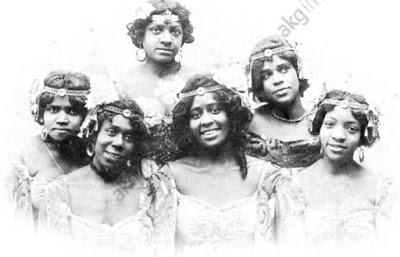
Around April 3rd, 1901, while riding a trolley to work, Emma noticed someone left a copy of the New York Herald beside her. She noticed an advertisement posted by German theatrical impresario, Paula Kohn-Wöllner, seeking seven Negro women with the ability to sing and dance for a concert tour of Germany. Emma replied to the advert and was promptly accepted. Ms. Kohn-Wöllner, who had previously managed two theatrical troupes in the 1890s in Leipzig and Chemnitz, had made a trip to New York to visit her two married sisters, when she got the idea to organize a Negro theatrical troupe to tour across Europe. Soon the troupe comprised of Ollie Burgoyne (26 year-old singer from the Oriental America show), Fannie Wise (19 year-old singer from Brooklyn), Florence Collins (26 year-old pianist from Kentucky), Alverta Burley (19 year old from Baltimore), S.T. Jubrey (32 year-old housewife from Virginia) and of course Emma Harris. Another girl, 20 year-old Corette Hardy was also accepted, but it was suddenly decided that she was to be left behind as a replacement in case any of the women decided to quit the newly christened “Louisiana Amazon Guard” troupe. On April 10th, the six women were brought to the Passport Office to apply for their first passports. After two weeks, on April 17th, with Ms. Kohn-Wöllner, paying for all six of the women's travel expenses, gathered all of them up and boarded them on the S.S. Deutschland heading for Germany. Built by AG Vulcan in Stettin and launched in 1900, the brand new S.S. Deutschland won the Blue Riband from Kaiser Wilhelm der Grosse of the North German Lloyd line, crossing the Atlantic Ocean in just a little over five days. She was the first and only four-stacker built for Hamburg America.
By April 21, the troupe arrived Germany, arriving soon in Leipzig, possibly debuting at the popular Central-Theater. Throughout June and July, the troupe made a series of successful performances at Kiel's Kaiserkrone and Carlsbad's Hotel Weber. In late August, the women intrigued Hungarian audiences at the Os-Budavara fortress. In September, the women fulfilled a month-long engagement at Vienna's Colosseum Theater. The following month was spent at Copenhagen's Cirkus Variete for the beginning of their brief Scandinavian tour.
In November, the troupe spent two successful weeks at Goteborg's Circus Madigan and two more weeks at Stockholm's Svensalen Variety Restaurant. Originally built in 1888 in an extension of the Sparreska Palace, the Moorish-style cabaret had recently re-opened in 1901 with electrical lighting and glass ceilings above that stage. In-between the their performances, on November 11th, Ms. Kohn-Wöllner conducted several interviews with the Svenska Dagbladet newspaper, frequently pushing forward Fannie Wise (fashionably dressed in a black and white dress). Ms. Kohn-Wöllner mentioned her plans to organize a band for the troupe, the contract she signed with the Folies-Bergere (for January 1902) and briefly mentioned her plans to bring over the standby girl still waiting in America. The troupe returned to Germany in December to entertain at Berlin's Circus Schumann where they ended the year, preparing for another year of extensive touring.
The new year of 1902, the group opened in Magdeburg for a two week engagement before moving on to France, where the women intended to perform at Paris' famous Folie-Bergere cabaret. Unfortunately it doesn't seem as if that ever came into fruition and the troupe returned to Germany to appear in Braunswich's Bruning Theater and Halle's Walhalla Theater.
The month of March was spent in Breslau's Liebich Etablissement, followed by performances at Danzig's Wilhelm Theater and Poznan's Kaisergarten in April.
In May, the group disappears briefly from the limelight as Fannie Wise and S.T. Jubrey suddenly quit the group and returns home to the United States. During this time their replacements, standby performers, Corette Hardy and Fannie Smith (20 year-old from Philadelphia) were promptly brought over to Europe. Throughout June, the troupe toured across Switzerland, performing in Zurich and St. Gallen before returning north to Germany. The month of July was spent at Munich's Deutsches Theater, followed by a month at Leipzig's Central Theater (September) and Dresden (October).
After twenty-one months of touring across Europe, in October 1902, during their Dresden engagement, the entire troupe walked out on their German impresario. Ms. Kohn-Wöllner was taken to court and accused of exploiting them financially. Lead performer, Ollie Burgoyne was elected as their new manager and now as the, "Five Louisianas", the women left for Berlin, where they entertained at the Orpheum Theater and Harmonie Circus. After a brief engagement in Trier and Aachen, the group suddenly disappeared.
In March 1903, Ollie Burgoyne and Florence Collins renewed their American passports and departed for London to join the cast of Hurtig & Seamon’s "In Dahomey", which opened on March 16th at the Shaftesbury Theatre. The four remaining women, now managed by American variety artist, William Crado, performed around Germany (and possibly other countries) for eight more months before departing for the vast Russian Empire.
|
|
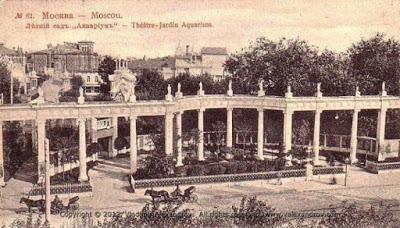
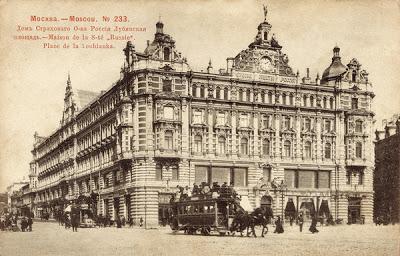
Moscow - Aumont Theater (also known as the Aquarium Theater)
|
Arriving in Russia around January 1904, the troupe appeared in Moscow at Aumont's French Theater. The focal point of Moscow’s lively nightlife, located at 16 Bolshaya Sadovaya Street just west of Triumphal Square, the Aumont Theater was an entertainment garden occupying several park like acres that drew clientele from the more genteel and prosperous classes of society, who weren't put off by the frivolous nature of the establishment's entertainment. A giant white colonnade entrance and a staircase bathed in electric light led into the gardens. In the center was a beautiful Moorish palace where bands played fashionable music, to the left was an elegant restaurant and to the right people strolled along gravel walkways past vendors booths selling snacks and souvenirs into the depths towards a spacious outdoor café chantant where gypsy Romanian orchestras performed. That evening, as the crowds made their way from the theater towards the open-air café chantant, the “Louisiana troupe” joined twenty or thirty variety acts onstage varying from trained animals, acrobats to operatic singers. The theater director, Charles Aumont, was a successful yet ruthless French-Algerian businessman that renovated the gardens in 1898 to make visitors feel like they've visited a magical world. Unfortunately, he rather well-known for exploiting the chorus girls and female performers to allure the largely male audience. After their turn onstage, the head Maître d’ (surprisingly a black man from Mississippi named Frederick Thomas) informed the women that as singers, they would be called upon after their performance to entertain the private parties.
|
|
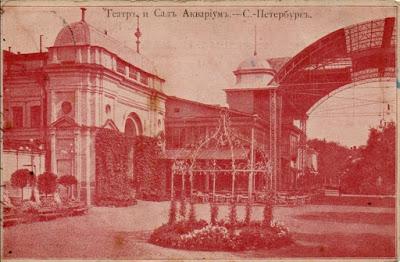
St. Petersburg - Theater Garden Aquarium
|
Shortly afterwards, the women traveled northwest to Saint Petersburg, to appear at the popular Aquarium Gardens. On February 8th, the Imperial Japanese navy launched a surprise attack on the Russian Pacific Fleet at Port Arthur in China. The two countries’ imperialistic ambitions in Manchuria had come into conflict. As the Russo-Japanese War raged in the Pacific Ocean and the Russian Far East territories, the troupe strutted across the stage and gardens of the Aquarium Theater, joining in the patriotic jubilation before the group without warning finally dissolved due to internal issues. Later that month, Emma convinced Coretté to remain in Russia with her and together they formed the “
Kristy Creole Duet”, while they continued to perform at the Aquarium. In March, the duo suddenly became the “
Harris Trio” with the addition of Fannie Smith, and together they departed for Helsinki with an engagement at the illustrious Hotell Fennia, where Finnish high society enjoyed to mingle.
|
|
Helsinki - Hotell Fennia (March 1904)
|
On January 22, 1905, while attending a party, hosted by popular American jockey, William Caton, in central Saint-Petersburg, the women witnessed the Bloody Sunday protest outside the Tsar's palace and riots across the city. The trio immediately packed up and returned to Moscow, where they resumed working at the Aumont Theater. In February, while performing in the city of Vyatka, the trio decided to dissolve and Corette and Fannie departed for Poland.
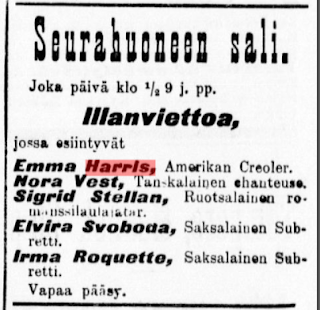
Now as a solo artist, Emma returned to Helsinki in March, performing for two weeks at the popular Princess Restaurant followed by two more weeks in the Finnish city of Tampere at the Seurahuoneen Sali. Shortly afterwards she returned to St. Petersburg and Moscow, where she met a handsome, English-speaking scientist and museum curator named Baranov. The two quickly became lovers.
Despite the '05 Revolution raging across the Russian Empire and the chaos increasing daily, immediately Emma embarked on an extended Siberian tour that coincided with Baranov's own personal lecture tour across Russia's expansive Volga region. Baranov accompanied her everywhere acting as her manager and promised to accompany her on a trip to the United States the following year. Since trains hardly reached many parts of Russia during that period, so much of the journey was using 'troikas' and were often followed by hungry wolves. Unfortunately, Emma discovered that her 'Grand Duke' was a charlatan. Baranov had been presenting her onstage as a singing African savage, manipulating and stealing her money after the show. Eventually the couple arrived in the city Kazan. Located on the left bank of the mighty Volga and Kazanka river and 520 miles east of Moscow, the former capital of the ancient Qazan Khanate was ravaged annually by bitter winters and scorching summers and was also surprisingly modern compared to the numerous Germanic villages and towns that lined the Volga. As the educational and cultural center of Russia’s vast Volga region, the city featured electric lighting, electric trams, telegraphs, telephones and Kazan Imperial University. Desperate to escape, Emma attempted to flee from her abusive lover only to be seized by several Tsarist gendarmes who dragged her away to jail. As the Russo-Japanese conflict was still raging, Baranov reported Emma to the authorities as a spy for the Japanese that was traversing across Russia under the guise of a performer. Eventually an intervention from Moscow's American Consulate allowed her to be released.
On September 2nd, the Russo-Japanese War ended tragically on September 2nd as the Russian Empire was forced to surrender to the Japanese. Scraping enough money teaching English around Kazan, Emma boarded a train to Moscow, where she sought out American Consul, Samuel Smith, who orchestrated her release from prison. The deeply racist, Consul Smith was shocked to discover that he had aided Negro woman from prison. Realizing she couldn't count on America for further help, Emma decided to scrape her plans to return the United States the following year and remain in Russia.
|
|
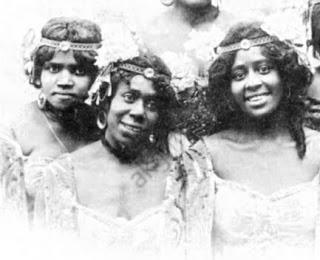
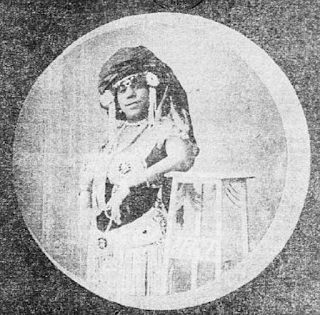
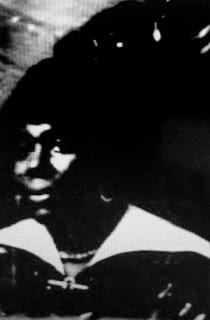
Emma Harris (on the Right)
|
Early 1906, a Baltimore businessman, Harry Leans, visited Russia and offered to fund Emma's first solo tour across the Russian Empire. Strangely, Emma decided to keep the African persona that Baranov had created for her becoming, "
Galima Oriedo: The Black Nightingale". She performed songs in German, French, Polish and Russian. Her specialty was Russian Romance songs, which were extremely popular in all of the major cabarets and theaters across the empire. In-between her songs, Emma demonstrated her ability to play the flute and ocarina, as well as her ability to imitate the sounds with her voice. It wasn't long before she became a popular operatic singer and classical dancer in Moscow and St. Petersburg.
|
|
Helsinki (September 1908)
|
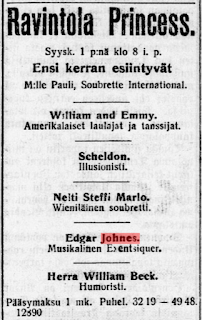
On June 6, 1907, the 1905 Revolution was finally extinguished with brutal force. Although order was established, the issues that sparked the violence remained and fueled the peasants' desire for revenge. A tense atmosphere gripped the country. There was the constant presence of the strongly emerging left-wing movement which was bent on purging the decadence of Tsarist Russia. This was, of course, the infant Bolshevik movement, but despite this business was booming again. After the revolution, a small suffragette movement swelled across Russia. The emancipation of women brought a shift in Russian society, billowing Victorian gowns were thrown aside and replaced by fashionable unimpeded svelte dresses designed by designer Lamanova. Divorced laws were eased in response to feminine demands for freedom of choice in marriage. Throughout the summer, theaters and cabarets reopened, foreigners returned and entertainers resumed their tours through the major cities. Throughout the year, Black entertainers traveled to Russia in droves. With the exception of random artists touring Europe, very few black people have ever been to Russia, and very few of them have remained in it to live. In the years that Coretté spent there, there seemed to be no more than a dozen other blacks in Russia — permanent residents among more than a million people. All across the Russia, Black performers such as Belle Davis, Abie Mitchell, Josephine Morcashani, the Black Troubadours, and the popular duo Johnson & Dean filled the music halls with excitement every night. They treated each other cordially and invited each new fellow Negro performer into their hotel rooms for breakfasts consisting of neckbones and beans to feel more at home. In St. Petersburg, a confectioner exploited the popularity of Ragtime by issuing the latest Negro minstrel hits on records pressed into discs of hard baker’s chocolate. Briefly between 1907-1908, Emma partnered with another American, forming the "William and Emma" duo that toured across Russia. The duo briefly traveled with Ollie Burgoyne and later popular African-American entertainer, Edgar H. Jones.
The year 1908 was full of success for nearly every African-American expatriate across the Russian Empire. In St. Petersburg, former leader of the old Louisiana Amazon Guards, Ollie Burgoyne was a popular headliner, mistress to a Russian noble named Sasha who provided her with a beautiful mansion on the outskirts of the capital and was preparing to a open French lingerie boutique. Corette Alefred had married a Russian theater director and become Coretti de-Utina, a popular concert singer. In Moscow, Miss Pearl Hobson (from the Florida Creole Girls) was a popular headliner at the illustrious Yar Restaurant. Also backstage at the Yar, was waiter Frederick Thomas, back in Moscow after the terrible 1905 Revolution and employed at the restaurant as the new artistic director and Miss Hobson’s manager. Around 1908, Emma had also settled in Moscow, becoming a popular fixture there.
During the summer of 1910, Emma was appearing in the strange and exotic city of Constantinople, a start to a lengthy Turkish tour. She found herself being chauffeured down Grand Rue de Péra, lined with many European-styled six story high ornately carved buildings. Everywhere, signs were written in Arabic and French. The fashionable Péra district was filled with businesses, restaurants, bars, shops and numerous café chantants to entertain the visiting Greeks, Armenians, Jews and Levantines. The exotic city reminded Emma of Moscow’s oriental nature.
She became such a sought after entertainer, that she was invited to Yildız Sarayı, the abandoned palace of Sultan Abdul Hamid II, to perform at the Imperial Seraglio (harem). Performing at all the popular hotels and music halls, she mastered the exotic belly dances, known as Raqs Sharqi which she soon showcased every night. She was eventually became so popular, that she was even invited to perform for the 12-year old Shah of Persia, Ahmad Shah Qajar (also known as ) and his elderly uncle, Ali Reza Khan Azod Al-Molk, who later died that September.
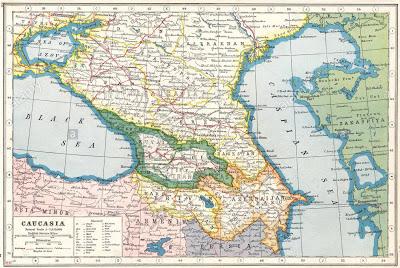
In January 1911, Emma returned triumphantly from the Ottoman Empire for the beginning of a lengthy tour across the Caucasus Viceroyalty. In the Georgian city of Tiflis (now Tbilisi) where she debuted at the Modern Theater. The following month, she was engaged at the Illusion Theater alongside a young black boy named Bomburo. Throughout the spring and summer, she was also possibly engaged in the Kars Governate, Azerbaijan and Russia's Kuban, Dagestan, Tersk and Batum Oblasts.
|
|
Tiflis - Illusion Theater (February 1911)
|
During the course of the tour, Emma became acquainted with a 28-year old Russian peasant, Alexander Ivanovich Mizinkin, who originated from Moscow. After a brief courtship, the couple immediately married and now with Alexander also employed as her impresario, Emma continued her tour throughout the vast Russian Empire. Around this time, Emma became a Russian citizen and Russified her name becoming,
Emmy Richardsovna Mizinkina (Эммы Ричардовна Мизикина).
|
|
Galima Oriedo - Rostov (January 1912)
|
On January 6th, the famous Algerian Arab performer, Galima appeared in Rostov-on-Don for a two week engagement at the Pel-Mel Cabaret (within the Maly Theater). By the spring as the Titanic sunk into the Atlantic, she was engaged in the Belarussian city of Braslav on April 15th, demonstrating her musical abilities and exotic dances at the Theater Uvarova.
That summer, the couple returned south, arriving the massive southern region known as the Ukraine, where they established a residence in Kharkov, the quiet provincial merchant city of 250,000 before a lucrative engagement at Odessa's North Hotel. The Kharkov Governorate, with a population of two million was filled with various small cities and villages where the Russian merchants and peasantry conversed in Ukrainian, Russian, German, Yiddish, Belarussian, Polish and Tatar. Kharkov county, which housed the Governorate capital of Kharkov, had a population of over 500,000 (Ukrainian - 55% Russian - 40% Jews - 3% Poles - 1%).
Settled in her country dacha in the surrounding rich agricultural areas, Emma strived to immerse herself into the aristocratic lifestyle that she'd witnessed across the Russian Empire, employing six servants and footman. In most households of Russian high society, there was an invisible glass barrier. Distinguishing the aristocracy from the workers was terribly important, but not always easy. The nobles walked on one side of the street, and the servants and peasants on the other. Although everyone attended the same churches, there was a separate entrance for the noblemen and their families, which led to a raised enclosure reserved for them. From the comfort of her home, she witnessed the miserable conditions of the peasantry, living in poverty, ignorance and filth from the cradle to the grave under the interlocking power of the landlords, the orthodox church and the Tsar. They lived upon small strips of land which was insufficient to support them. They often were forced to work an allotted number of days on the vast estates of the wealthy landowners or for Kulaks (rich peasants). If they were unable to pay their taxes, the gendarmerie payed them a visit, seizing their horses, hogs, cows and anything else of value. She felt for the peasants, but maybe it was alright for her to be a little selfish after three hundred years of American slavery and oppression.
In August, she was visited by her old acquaintance, 49-year old Negro comedian Edgar Jones, who was in the middle of one of his usual Ukrainian tours. He had been touring around Europe for 21 years, having arrived in 1891 with the "
Afro-American Specialty Company". In 1904, as his European career began to falter, Edgar began frequently appearing across the Russian Empire, spending little time home in Berlin, where his wife Amelia Jones and four children lived at Kleine Hamburgerstrasse 2. After a brief visit and settling in a Kharkov hotel, Edgar departed to the city of Lebedin (now Lebedyn) for a performance. Unfortunately, on August 29th, he died of heart paralysis and was hastily buried in the Troitskaya Cemetery. Emma aided the governor of Kharkov and Odessa's American Cosulate in burying Edgar Jones and sending his possesions of clothing and musical instruments to his family in Germany.
The following month, as anti-government protests raged across Russia, a double agent shot and killed Prime Minister Pyotr Stolypin while he attended a performance at the Kiev Opera House. The Tsar was so near the Prime Minister, that he heard the shots himself. A sense of doom settled over Russia, many felt apocalypse was fast approaching and no one and nothing could stop it.
|
|
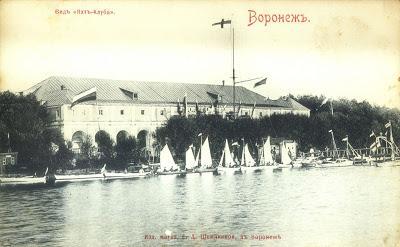
Voronezh - Yacht Club (July 1912)
|
The country-wide celebration, known as the Romanov Tercentenary, started 1913 off with a bang. This celebration marked the 300th anniversary of the Romanov dynasty beginning with a week of receptions at the Winter Palace in February before the Imperial family took a pilgrimage in May to Moscow and the numerous cities that once occupied the ancient territory of the Grand Duchy of Muscovy. Emma spent the year touring across the various Ukrainian governorates.
During the summer, she arrived in the Voronezh Governorate arriving in the governorate seat, Voronezh in July. Upon her arrival, the Black Nightingale took the city by storm. She thrilled audiences for two days at the Fantasy Gardens and another successful engagement at the Petrovsky Yacht Club. Newspapers printed positive reviews of the way she would open her act playing a flute and ocarina, before imitating those instruments with her ethereal voice. Then after performing a series of Russian romances in fluently, she began vigorously dancing her exotic snake-like Algerian dances which sent audiences into a frenzy. Early October, Emma was in Odessa performing at the popular North Hotel, which had been renovated the previous year, adding a permanent music hall in the gardens behind the hotel. Odessa was a polyglot city and a cosmopolitan city, and theatrical life there was in full swing. Its population numbered 630 thousand people, a third of whom were Jews and 30 thousand of whom were foreigners - Greeks, Armenians, Germans, Romanians, Italians and many others. With its wide, straight, shady streets and elegant stone houses, it would not be out of place anywhere in the Mediterranean. The city was an important trading center and, despite its distance from two capitals, it was never a quiet or provincial city. Trendy restaurants and hotels, gourmet shops, popular cafes and several theaters enjoyed the attention of many wealthy citizens. Sailors from exotic ports mixed up with the city robbers in noisy taverns next to the commercial port. On the outskirts of the city, the coast of the estuaries was littered with villas, looking at the sparkling sea surface.
During her engagement, Ophelia Gindra, daughter of an Austrian millionaire, fled to Odessa's North Hotel with to elope with boyfriend who quickly her abandoned upon arrival. During this time, Ophelia witnessed the Black Nightingale perform her exotic routine in the garden café-chantant. Emma took the girl under her wing and attempted to help her employment as a singer at the hotel. Unfortunately, the director refused to hire her and the Black Nightingale’s contract was coming to an end soon. On October 10th, Emma offered to take the girl back to Kharkov with her, but while at the at the Odessa train station, she attempted to persuade Ophelia to return to Austria. Instead, Ophelia committed suicide by consuming potassium cyanide, dying within seconds. Emma was promptly arrested and sent to Odessa’s American Consulate, where she was soon released and sent immediately home to Kharkov. On October 17th, in between her performances in Kharkov at the Michel Teatr and the Kommerchesky Club, she conducted several interviews about the incident with the New Odessa and Morning of Kharkov newspapers.
|
|
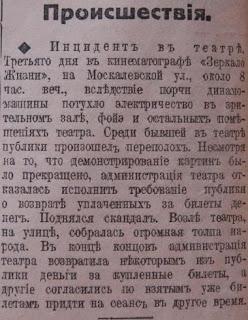
Kharkov - Zerkalo Zhizni Cinema
|
In the winter of 1913, with the earnings from Emma's frequent touring, Alexander purchased the popular Zerkalo Zhizni cinema from a Mr. G. Schmidt. The quaint newly renovated stone two-story 'Mirror of Life' cinema on 32 Moskalevskaya street was built in 1871 by the peasant M.T. Egorov (and designed by Ukrainian architect A.D. Rakov) and was among the first cinemas built in the Ukraine. By 1912, it was the most popular destinations in Kharkov. In the foyer, live music entertained movie goers as they helped themselves to a buffet of pies, cakes, ice cream and soda. In between the Russian and American films that were showcased to packed houses, pianists, violinists and singers offered brief performances, often the Black Nightingale herself gave concerts.
On February 4th, 1914, the electricity suddenly shut off at the Zerkalo Zhizni Cinema and chaos ensued. Outside an angry crowd gathered and Alexander calmed them, returning their money and promising everyone one film free of charge the following day.
On June 28, 1914, Gavrilo Princip assassinated Archduke Franz Ferdinand of Austria in Sarajevo, setting in motion the events leading to the outbreak of World War I.
On July 25th, according to later passport, Emma paid Moscow a visit. Possibly in preparation to relocate back north, or possibly taking an opportunity to visit Frederick Bruce Thomas. Thomas (now using the Russified version of his name Fyodor Tomas), had become the owner of the old Aumont Theater in 1911 and had converted it into Moscow's popular amusement park, the Aquarium Garden Theater. Besides its numerous various entertainment establishments, the park also held private residences, hotels, cafes and cinemas. The latest attraction at the Aquarium, was Jack Johnson, America’s Heavyweight Champion, who was preparing for a magnificent boxing tournament between Johnson and M.P. Tsarev that was initially to be held on July 28th. However the tournament was called off due to the news of chaos coming from other parts of Europe. Jack and Emma would've witnessed off-duty army officers spending time at the Aquarium, sipping champagne, staring at the chorus girls and some of them meeting and dining with the black American boxing champion. Unfortunately, August 1, Germany declared war on Russia and on August 3, on France. As the Russian Empire prepared for mobilization, Jack Johnson and his wife caught the next train to Paris. Emma herself promptly returned home to Kharkov and began liquidating her various properties.
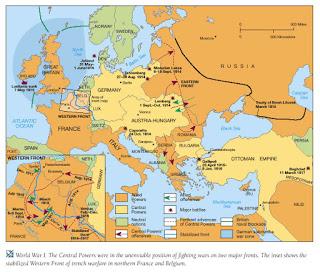
On August 4, after Germany invaded Belgium, while simultaneously attacking France, Great Britain declared war on Germany. On August 23, Japan entered the war on the side of the Entente. Throughout the Russian Empire, the war was greeted with an eruption of patriotic fervor. Posters appeared everywhere, calling every able-bodied man to help defend their country. Men were seen standing in long lines to enlist (or to answer the draft), boys were boarded into trucks heading for their local regiment bases. On every street corner stood a soldier. It wasn't long before Alexander was drafted and sent off to the Front. Russia entered a period of unprecedented bloody savagery which would last for seven years and claim the lives of more than ten million people. No other country paid the price for the folly of 1914 as Russia did. Since the outbreak of the war, Russia's lack of arms and ammunition was quite apparent. The shortages became so severe that soldiers were sent to the front without guns and ordered to look for them amongst the dead. Many soldiers didn't even have boots. The officer corps, half of which were noblemen, suffered terrible losses in the first battles against the Germans. In the early months of war, many families began following the action closely on a large map of Europe. Most men were away fighting on the front lines, leaving the women and children behind alone in the villages and cities. Caring for the sick and wounded soldiers became a popular way for noblewomen to do their part for the war effort. Although most of their motives were honest and sincere, there was some elements of vanity and rivalry amongst the aristocratic women to see who could house, feed and care for the soldiers more splendidly than the rest. Other nobles, such as the Sheremetev family, converted several of their properties into hospitals, organized shipments of relief packages to Russian prisoners of war, helped bandage the wounded at private infirmaries and formed organizations dedicated to helping war orphans.
On September 1st, the Tsar declared that St. Petersburg would from then onwards be known as Petrograd. Russian high society began basking in what would be the Russian Empire's last spectacular year and to be Russian society's greatest season. There was a feverish desire to have a good time to combat the undercurrent of nervousness. It was possibly a large distraction upon newspapers reporting on October 29 that the Ottoman Empire attacked Russia. All of Petrograd indulged in wild partying, amusement and merrymaking before the Tsarist government initiated prohibition that November (alcohol was banned for the remainder of the war). One highlight of the year was Countess Shuvalov's black and white ball, with the uniformed Chevalier Gardes in attendance. Everyone spent their evenings out at the opera and attending parties. Emma entertained at the popular establishments, watching everyone dance the tango and downing champagne to the wailing of gypsy singers, red-clad Romanian violinists and clinking glasses. Everyone was spending money as quickly as they could because they weren't sure what was to happen next.
|
|
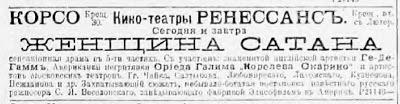
Kiev newspaper advertising "Satan's Woman" (Mar.29, 1916)
|
In January 1915, in the middle of a very cold winter, the attention of Russians was riveted to another terrible wave, reports of war in Galicia. Austro-Hungarian troops launched a counter-offensive against the Russian forces in the Carpathians. But this attack was a fiasco, and by March the advancing Russians had taken the great fortress of Przemysl, thus preparing for the march along the pass to Budapest and Vienna - the two capitals of the Habsburg monarchy. Dramatic events unfolded in the south and the Russian populace watched them, experiencing a mixture of anxiety and arousal. At this time, Russia opened a second front - in the Caucasus Mountains and the Black Sea. The Ottoman Empire was its longtime enemy, which is now united with the Central Powers. Two months after the start of the war, Turkish warships shelled cities on the southern coast of Russia, including Odessa. In response to this chaos, the Mizinkin household relocated to Moscow, where Emma had purchased comfortable apartment on 12 Bol'shoy Kozikhinskiy Pereulok in the center of the city. Also inhabiting in the apartment building was the popular Russian actor from the Maly Theatre, Alexander Ostuzhev, who was appearing successfully in the production of V. Sardu's "Graf de Rizoor". Less than ten minutes away on the Bolshaya Sadovaya, was Fyodor Tomas’ Aquarium Garden establishment.
Lonely in the middle of Moscow without her husband and unable to tour due to the war, Emma decided to embark on a film career. After writing a scenario together with directors Sigmund Veselovsky and Parkomenko, Emma traveled to the G.I. Libkin Studios in Yaroslavl to star in her debut film "Satan's Woman". Released May 15th by the Alians Film Office, the 5 hour, 1350 meter film was an interesting attempt on Russian soil to create an intricate American adventure-drama.
Film Scenario:
"Famous circus actress Gaia Assi (Ge-de-Gayam), a charming and beautiful woman, enjoys great success with men. Not loving anyone except her devoted Arab Emerita (Emma, credited as Galima Oriedo), she pursues one goal - to fall in love. However, no one touches her suffering and the cold laughter of celebration meets hot recognition of its victims. On a ride she meets a banker who is find of her, she also meets and soon conquers the heart of the engineer Lamanca, who saw her performance in a circus. Entertainer Yevgeniy Tolsky (Nikolai Saltykov), former lover of Miss Assi, was terribly jealous of her new banker lover. Gaia still possessed affection for Tolsky, much to the chagrin of Emerita who was deeply in love with him.
The banker walks in on Gaia kissing Tolsky, however Gaia recovers her relationship with him by inviting everyone to a party at her home. She also asks that Tolsky bring along his brother Andrei (Lihomsky), a popular sculpture artist. At the party, guests demand that Gaia dance and she performs the dance of fire much to the delight of everyone. While Gaia spent much of the evening snuggling up with her banker, the sculptor Andrei realizes she is the woman of his dreams and wants to sculpt statues of her. Tolsky overhears his brother and an argument ensues. Eventually the banker gets in involved and Tolsky challenges him to a duel. Tolsky injures the banker and returns to the party to search for Gaia, only to find her embracing Andrei. Rushing out from her bedroom, Emerita attempts to comfort Tolsky. Unfortunately he pushes her away, locks himself in the next room to commit suicide. Hearing Emerita’s cries, Gaia and Andrei discover the horrible tragedy that has occurred. Emerita embraces the cold body of her dead love interest, blaming his death on Gaia and Andrei.
Disgusted, Andrei loses interest in the beautiful dancer and immediately decides to seek revenge on his brother. Conspiring with a friend, Andrei kidnaps Gaia in a automobile to an abandoned cellar. They're unaware that Emerita had followed behind them in a taxi and finds a way to rescue her starving friend from the cellar. As the women escape, they're followed by the men until the pursuers get caught in a car accident. Later on, while Gaia is home entertaining a new potential lover, Andrei sneaks into her home and poisons the coffee right before she begins serving refreshments. Gaia, in agony from the effects of the poisoning, is approached by Andrei who declared that he was once in love with her but now was lost to him. During his speech, Gaia used the last of her energy to grab a dagger and murder Andrei before she also succumbed to death."
Naturally, Emma became an overnight sensation due to the success of the film.
That summer, Russian officers found themselves wasting scarce artillery shells on their own troops in a desperate attempt to get them to fight. So dreadful were the conditions at the front, that many soldiers shot off their own fingers to escape the carnage. Many began to desert and return to their villages, which had been nearly drained of men. That same summer at Moscow's Aquarium Garden, Fyodor Tomas sold tobacco, then sent the proceeds to the troops. Elsewhere, bazaars were organized to sell items to raise money for the troops. On June 12th, for the first time in five years, Emma bothered to renew her American passport. Although there are discrepancies, as she claimed to have been born in Washington D.C. in 1886.
In September, Tsar Nikolai II made the disastrous decision to replace Grand Duke Nikolai Nikolaevich and assume supreme command of Russia's armed forces. From that point onwards, the military's mounting failures were blamed solely on the tsar. With the tsar off at the front, Tsarina Alexandra, along with the mysterious holy man Grigory Rasputin, took command of the government. Rasputin's murky influence and the negative public perception of the German-born Tsarina as an enemy spy fed talk of dark forces at work that destroyed Russian society's waning trust in the Romanovs. Everywhere, pamphlets were distributed claiming: "To be for the Tsar is to be against Russia!" Everyone, even Imperial family members, begged Tsar Nikolai for change and reforms to allow society a greater voice in the government, although it was likely to late by then to halt the drift towards revolution. Society's lack of trust in the government was matched by the government's distrust of the people. Convinced that the people, particularly the bourgeoisie, presented a grave threat to the crown, the Okhrana kept surveillance on the wealthy. Private homes were being monitored for subversive activities. The government feared many aristocratic women were inviting military officers in their salons and encouraging seditious talk. Government agents believed the elite's alienation from the throne a more serious threat than the one posed by the poor and disenfranchised. Many aristocrats found life in the city burdensome and many retreated to their country estates. Before the year was over, the Kinolent Film Office released the comedy film, "Feet Up!", in which Emma starred alongside actor Tikhomirov. It was directed by Boris Kramskoy, whom also held the main role within the film. It was possibly an attempt to cheer up the glum Russian audiences and take their minds off the war.
|
|
Mizinkin Residence - 4 Kalanchevskaya (1916-1933)
|
In 1916, with Alexander back home from the Front, the couple purchased a 15 room house located at 4 Kalanchevskaya Pereulok in eastern Moscow's working class Krasnaya Vorota district. The five-story Art Nouveau style house, designed by the architect Alexander Nikiforov and built between 1875-1880, was located in the railroad infested Krasnoselsky district. As usual, the sumptuously decorated house was kept in order by a team of six servants and a footman. Besides Emma's cabaret performances and film appearances, in order to supplement an income, the Mizikin home also doubled as a high class brothel that serviced soldiers and aristocratic clientele.
By mid-1916, while the mood was falling in the country, the feverish atmosphere began to penetrate into the entertainment that civilians and military were looking for. On the eve of the war came from Argentina, flew to Paris and sped around the world a new dance fashion, the Tango. During the war years, the popularity of tango increased; however, some professional dancers and singers brought ominous notes to his elegant, stylized eroticism. One couple became famous for their "Tango of Death", in which a man, dressed in a flawless tail coat, was made up in such a way that his face looked like a skull. It was a melodramatic echo of the gloomy news coming from the front.
Throughout the year, with millions of peasants sent off to the front, food shortages loomed over Russia and the rapid increase in the price of goods fueled larger and more frequent strikes in the cities. The gendarmes were becoming reluctant to repel the masses of protesters, instead many policemen began joining the crowds, shouting: "Down with the War!" Once, while Grand Duchess Xenia's automobile drove through the streets of Petrograd, a group of street kids chased the car and pelted it with snowballs, yelling, "Down with the filthy bourgeoisie!" On the night of December 16th, a group of men led by Prince Felix Yusupov murdered Rasputin in an attempt to free Russia from his mysterious influence. Profoundly shaken by his death, the Tsar and his family retreated into seclusion. Petrograd became a massive lunatic asylum, discontent rising with each day. The dire food shortages, combined with the 300% inflation left Russia on the brink of revolution on the part of the lower classes.
By the beginning of 1917, Alexander was a full fledged member underground revolutionary movement, and Emma decided to follow in the footsteps of her husband and attempt Bolshevik rallies across Moscow. Unfortunately during a public demonstration held in Moscow sometime in January 1917, Emma witnessed armed gendarmes fire upon the crowds and was soaked in blood as a man beside her was murdered in cold blood. On February 6th, she renewed her American passport, expressing a wish to travel to neutral Scandinavia.
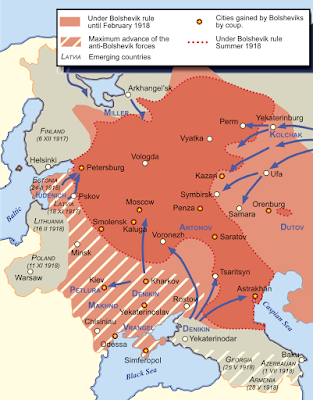
Two months later, on March 8th (O.S. February 23), 1917, over seven thousand female textile workers from St. Petersburg's Vyborg district, marched through the streets crying for bread. The shortages had left the lower class starving, cold and desperate. Banners were erected everywhere, denouncing both the war and the Tsar. The crowds began breaking shops windows and raiding bakeries. Before the day ended, as many as ninety thousand had marched through the streets before order was restored. The revolution, however, had just begun. Throughout the night, Bolshevik revolutionaries organized further strikes and marches into the city center. The following morning, more than three hundred thousand workers from the northern outlying neighborhoods, crossed the Neva river at Alexandrovsky Bridge where they pushed through several hundred Cossacks on their way towards Nevsky Prospect. The city's fine inner-city neighborhoods had not seen such chaos since the 1905 revolution. By March 11th, Cossacks patrolled the streets and machine guns were positioned everywhere. Street gatherings were banned and residents were warned that the authorities were ordered to confront any unrest with force. Despite these measures, protesters filled the streets only to be met by gunfire. All the blood spilling in the streets caused many soldiers to mutiny and join the mobs. On March 12th, half of the city's 160,000 man garrison had joined the revolutionaries. Prisoners across the city were released into the streets, gendarmes were murdered, courthouses, arsenals, shops, private homes and the Ministry of the Interior were looted and ransacked. Mobs killed any respectable looking men, causing many gendarmes to strip their uniforms and flee the city. At the Mariinsky Palace, government ministers met to resign from their positions before slipping out of Petrograd by nightfall. Towards the end of the day, a red flag was raised above the Winter Palace. The capital was now under Bolshevik control. On March 16th, Tsar Nikolai abdicated and as their world dissolved around them, many aristocrats fled to the countryside. The old order evaporated and anarchy spread. While the Duma met at Tauride Palace to consider how to address the chaos, a rival political power, the Petrograd Soviet of Workers & Soldiers Deputies, held a meeting in the palace's right wing. The new provincial government, in order to win the support of the Soviet and it's the leader, Vladimir Lenin, agreed to an amnesty for all political prisoners, freedom of speech, press, and assembly. They also agreed to the abolition of all restrictions based on race, class, religion, and nationality. The Okhrana and corps de Gendarmes was also to be abolished. The Bolsheviks began attacking the Burzhúi (bourgeoisie), or anyone classified as privileged. All it took was a starched white shirt, smooth hands, eyeglasses, a woman's hairstyle or even any evidence of bathing could classify a person as Burzhúi, causing an angry mob to set upon you. In Moscow, after the initial intense clashes between the troops and the rebellious crowd in front of the City Duma building near Red Square, the soldiers joined the rioters, tied red ribbons on bayonets. Crowds poured into the streets and squares in the city center, carrying red flags in support of the revolution in Petrograd and singing to Marseillaise. On Sunday, March 25, a huge “parade of freedom” consisting of hundreds of thousands of people passed through the heart of Moscow.
After the February Revolution and with Russia in a dire situation, Emma’s artistic career was suddenly interrupted and like the rest of the American expat community she pondered at the idea of returning to America. The war and revolution had abruptly ended Russia’s importance on the continental theatrical circuit. Extensive touring was impossible and many Russian establishments began shutting down. The vast majority of the African-American community in Russia were rushing to Petrograd’s American Embassy and Moscow's Consulate to apply for passports in order to sail across the Black Sea towards Turkey and Romania or board Trans-Siberian trains towards Manchuria and Japan in their journey back to America. However, letters she received from friends such as Ollie Burgoyne, Saidie Sellyna and Ida Forcyne who had returned home to America , she was able to learn about the changes in the American entertainment scene. The majority of Black establishments only wanted light-skinned Negro women, Harlem cabarets had women perform shake dances in between the tables and mingle with the audiences as Jazz wailed in the background. Such activities didn't happen in Russian cabarets and music halls. Most of the successful Negro performers returning to America from Europe, found themselves suddenly penniless and turning to domestic work. By May, Russia was already adapting to the country's new political reality, although most activities continued as before. Although it was noted at every prestigious venue, the 19th-century opera "A Life of the Tsar" was hastily dropped from the repertoire. Not everything was festive or peaceful. Moscow's police forces were disarmed and disbanded by the rebels. The Provisional Government declared broad civil liberties, it also pardoned all political prisoners, including terrorists; in addition, about two thousand thieves and murderers were released from prisons in Moscow. The city was flooded with a wave of crime - there were looting in the streets, attacks on houses and businesses. Even the Mizinkin residence was looted, the thieves getting away with many valuables, including Emma's American passport. The new city militia, which consisted mainly of volunteer students, was ineffective, and homeowners were forced to organize their own associations for mutual protection.
On November 7th, the Bolsheviks struck again in Petrograd. Two days earlier, having changed his appearance, Lenin left the temporary asylum in Finland and slipped into the capital; he managed to convince his comrades that it was time to take power. Red troops, coordinated by Leon Trotsky - a talented assistant of Lenin - occupied a number of strategic sites in the city. That night, the Bolshevik-led soldiers, sailors and factory workers attacked the Winter Palace, the former royal residence where the Provisional Government met. A small defense force in the palace, consisting of two or three junkers' mouths and a part of the women's battalion, was suppressed after several hours of confrontation. Bolsheviks arrested members of the government; Kerensky, who had become prime minister by that time, was able to escape by taking a car at the United States embassy. In Moscow, there was more serious resistance. The next morning after the fall of the Provisional Government, the Bolshevik troops surrounded the Kremlin and encountered the Cadets from the city military schools and a small number of Cossacks. Both sides accused each other of illegitimacy and refused to retreat. The first to open fire were the Bolsheviks. Over the next few days, fierce battles raged between the "red" and the few units that remained loyal to the Provisional Government in various parts of the city. The situation quickly became so chaotic that the city seemed to have fallen into schizophrenia: on one side of the square people were queuing for the daily bread rate, and on the other, at that very time, the Cadets and the “Red” squadrons exchanged fire. At the beginning, Moscow's railways, post offices and other government offices continued to work, while heavy fighting broke out throughout the city. However, By November 10, trams no longer ran and telephones did not work. Banks and businesses were closed. Out of fear of getting a bullet or shrapnel, people tried without need to leave the house. On the streets, patrols began to appear, consisting of aggressive Bolshevik soldiers and rude-looking workers with rifles on ropes. In apartment buildings, members of the house committees collected firearms, which they could find, and in turn guarded the entrances from marauding gangs of armed men, whose beliefs were questionable. The rest of the tenants were asleep at that time - dressed, in case someone tried to break in.
Throughout the course of the October Revolution, Emma and her brothel girls banded together and tended to the wounded Bolsheviks that they dragged inside from the daily street skirmishes. By the end of the week, dozens of buildings in the center of Moscow were damaged by shots from rifles and machine guns and artillery fire, including the most revered cathedrals in the Kremlin itself. On November 20, the Moscow Military Revolutionary Committee proclaimed its victory, declaring that the Cadets and its other opponents had surrendered or been killed. On November 29th, Emma used her connections to gather the ingredients to produce a large Thanksgiving feast for American Consul Maddin Summers and the remnants of Moscow's dwindling American Consulate staff.
If Emma had any plans to leave, her time was running out. The Bolsheviks did not want people to slip out from under their power, and everyone who wanted to leave Moscow had to get a special permit. Train traffic throughout the country had deteriorated greatly: the schedule became irregular, tickets were in short supply, rolling stock deteriorated, delays became frequent due to engine failure. In addition, landing on a train in Moscow did not guarantee the achievement of the destination. At each station, so many people tried to get on the train that the passengers had to fight for their seats. Of course being an entertainer, she could've used the loophole that existed for actors and other performers stating that she was still on stage and had to go south to work on her profession. Instead, however, Emma enlisted with the Red Cross, serving as a nurse aboard armoured train no.1045 that traversed south into the Ukraine.
As soon as she returned home to Moscow, on March 3, 1918, the newly formed Soviet Union backed out of the war after the signing of the Brest-Litovsk Treaty. Ten days later, 30,000 German and Austrian troops marched into the Ukraine, by mid-March, the Germans were already in Odessa and the new puppet state became known as the Hetmanate. The region became terribly dangerous, besides the Red Army attempting to push out the Germans, the Ukraine's notorious criminal gangs (their brazen behavior comparable to Chicago's gangsters) began a reign of terror with nightly burglaries and murders in the streets.
On March 11th, as Moscow was declared the new capital of Soviet Russia, Vladimir Lenin and the Soviet government arrived from Petrograd, hastily settling themselves in the city. Emma attended a massive rally held in Red Square, where Lenin gave a powerful speech. Standing on Skull Place before the massive St. Basil’s Cathedral, Lenin was explaining the meaning of the Bolshevik cause when he spied a smiling, middle-aged black woman at the forefront of the crowds. Extending his right hand, he spoke directly to Emma, “The ideal communist is to open the road for all the downtrodden races of the world. For you, comrade, especially, as we regard your race the most downtrodden in the world. We want you to feel when you come to Russia that you are a human being. The Red Army is ready to give its life at any time for all the downtrodden races!” Immediately the crowds hoisted Emma up upon their shoulders and bore her triumphantly through the cheering audience.
Due to the deteriorating health conditions in the city, cholera and typhoid began to spread. Moscow was also on the verge of starvation, the main food products were issued on the cards, and prices on the black market were too high. It was then, in order to partially fill the gap, small businessmen appeared, which became known as the “bagmen”. Crowds of peasants began to arrive in the city from distant villages with bags of local foodstuffs — flour, bread, butter, cereals, eggs — which they exchanged for industrial goods still found in the city on the black market, such as women's headscarves, chintz , strings, sugar, soap and matches. Hungry citizens also made such trips - in the opposite direction. The Bolsheviks viewed this trade as a form of illegal speculation and tried to thwart it, but the need was great in the city, as was the divergence of prices in the city and the village, and this made the risk both necessary and profitable. Inevitably, the stations in Moscow became one of the main places where buyers and sellers met. Living between Moscow's three major railroad stations, Emma became a frequent black market shopper, having very little issues due to her numerous connections to Russia's criminal underground. Her connections also proved to be valuable when the Bolsheviks the new Cheka secret police began targeting private residences to confiscate, rob and extort the bourgeoisie. Across the city daily, homeowners and tenants were often simply thrown into the street as representatives of the new order drove into their houses and apartments. It was certainly interesting that throughout the course of this plundering, a popular African American actress was able to maintain control over her massive home in the heart of Moscow.
That summer, Emma would've found herself unemployed. No longer the wealthy aristocrat she once was, she now listed in the category of the declasse bourgeoisie. The Soviet government began liquidizing and nationalizing all theaters, cabarets and music-halls. Even, the once popular Aquarium establishment was being occupied by a local military garrison. Besides earning enough income from her successful brothel, she soon found employment with the
Narkompros. Shortly after the October Revolution, the old system of education and culture management was destroyed and the new system, gradually with great difficulty was created. With the establishment of Soviet power, teachers, university professors and cultural figures were unable to find a common language for the development of education and culture in the new Soviet Union. Thus in response, the People's Commissariat of Education (Narkompros) was organized.
Much of 1919, Emma was sent east to Simbirsk with a delegation of the
Narkompros to aid in the establishment of educational and cultural centers. Her primary job was that of an interpreter and English teacher to Soviet officials. Simbirsk (now Ulyanovsk), a bustling provincial city on the banks of the Volga and Sviyagi rivers with a population of nearly 64,000, was on the frontlines of the Russian Civil War's Eastern Front. Due to the Civil War, the city was practically in ruins, local industry was disrupted due to a lack of fuel, tools and raw materials. Street lighting disappeared, boulevards and parks were neglected, houses were destroyed and bazaars and shops were abandoned. Not far from the city, Commander Jan Blumberg and his 5th Army armed with 10,000 men, 42 guns and 142 machine guns held off the White Guardist's Western Army led by Mikhail Hanzhin. Since February 7th, the city had been the headquarters of the Revolutionary Military Council (headed by Commander Sergei Kamenev and Sergei Gusev), leaving the city swarming with military personnel.
Anti-revolutionary in sympathy, during her sojourn in the city, Emma became involved with various White Guard military officers, aiding them in their schemes against the new Soviet government. During the summer of 1919, after Simbirsk was briefly captured by the Czechoslovak Legion, she returned home to Moscow, continuing to work with the White Guardists, offering her Moscow home as hiding spot and meeting place for them.
On September 24th, the Cheka raided the Mizinkin residence where they discovered numerous White Guard soldiers holed up. The entire group (including Emma) were swiftly arrested and taken to the infamous Lubyanka Prison. Built sometime before 1772, the Neo-Baroque building, originally a luxurious residential building on the Malaya Lubyanka. In 1918, the Council of People's Commissars, the building was liquidated and nationalized. Around May 1919, the building was transferred to the Special Section of the Moscow Cheka. While Emma sat quietly in her cell, the White Guard soldiers were executed by firing squad.
On November 19th, after two months Emma was brought before an Cheka Official whom was looking into her case. She immediately denied any knowledge of the counterrevolutionaries, claiming she was simply running a legitimate business and didn't engage in politics with her clientele. The official replied, much to her surprise, “You know the only reason we didn't shoot you was because you’re a Negro. You’re free to go now. I advise you to find some useful work. Keep out of trouble.” Emma was promptly released.
On February 11th, 1921, the People's Commissariat of Education was dissolved. Shutting down her successful brothel, Emma converted her beautiful mansion into comfortable American Pension, where she housed Red Cross officials, journalists and other Westerners. Being located between three major railway stations, she soon managed to arrange for all the railway information bureaus to immediately direct every visiting Americans to her establishment.
That summer, after the Civil War finally drew to a close, a terrible Great Famine raging across the Volga region known as Russia’s breadbasket. If 49-year old Emma Harris-Mizinkin had any aspirations of resuming her concert tours, those plans would've immediately dissolved. In September, when the American Relief Association, Colonel Haskell, arrived in the Soviet Union to aid the Russians in their fight against famine, Emma organized a laundry service for the ARA relief workers based in Moscow, while Alexander delivered the wash and called for it.
During this time, Emma reunited with her old friend, Coretté Alefred (now Coretti Arle-Titz), whom had recently returned to Russia from the Ukraine with her new husband Boris Titz. The couple decided to reside in Moscow instead of Petrograd, which had once been Coretti’s stomping grounds. The two women most likely hadn't seen each other since the 1917 and Emma would've been extremely shocked upon hearing Coretti’s false tales she spun to Soviet newspapers, including one story that she originated from Mexico, among other tales.
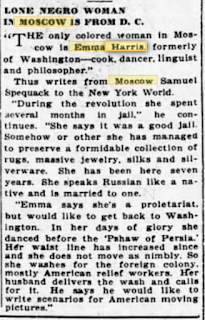
In Late-1922, Ukrainian born American journalist of the New York World, Samuel Spewack and his wife Bella traveled to Germany and the Soviet Union, where they resided for the next four years. On September 9th, during their surjourn in Moscow, Samuel paid a visit to the Mizinkin residence only to shocked to discover that despite the Revolution, Nationalization, Civil War and the raging famine, Emma was able to maintain possession of her fine collection of rugs, massive jewelry, silks and silverware. In between cooking, Emma rambled on (in fluent Russian) about her days as a exotic dancer, performing for the Shah of Persia, her disappointment that she could no longer move nimbly as she once could since her waistline had increased and also expressed her desire to return to the United States. Her husband, Alexander, also chimed in expressing his desire to travel to America as well to write scenarios for Hollywood films.
Early 1926, marked the end of Emma’s career as a successful actress as she sought employment as a textile worker at the Proletarsky Trud Silk Mill. This new shift in her life also marked the end of her fifteen year marriage with Alexander Mizinkin, who moved out some time later. In the meantime, the Soviets finally seized control over her magnificent mansion , giving Emma two rooms on the first floor, converting the remarkable rooms into apartments where ten Russian families soon inhabited. With all six of her servants dismissed, Emma was frequently accompanied by a Lithuanian servant, one of her former prostitutes, who provided assistance whenever Emma built an improvised kitchen in the common corridor of the building, where she spent hours busy with pots and pans cooking up hash, pork and beans, beef stew, cabbage and ham hocks, fried chicken and cornbread.
Although her American boarding house was gone, Emma continued providing southern hospitality to every visiting American that she came across. “Just supply me the rubles, I’ll find the stuff.” she would say to any American that wanted a home cooked meal, although how she was able to obtain the ingredients in food-scarce Moscow is still a mystery. The early groups of African-Americans, such as Harry Haywood (who arrived in April 1926), quickly grew fearful spending time around Emma. Now classified by the Soviets as a declassé bourgeoisie, she was extremely bitter about her present situation and frequently criticized the Soviet regime, meanwhile praising the old Tsarist system. She was often recalled saying, “I'm like a cat with nine lives, honey. I always landed on my feet...been doing it all my life wherever I been. These Bolsheviks ain't gonna kill me.”
In late 1928, American communist from Idaho, James Pierce, arrived at the Soviet Union for five-year stay in Leningrad and Moscow. By September, he secured a room at Kalanchevskaya 4, eventually becoming very close with Emma. Her apartment had became regular Saturday evening meeting place of American expats. In between serving home cooked meals, Emma pounding out jazz numbers on her piano coupled with her melodious singing added a dash of color to the drab grey Russian winter.
During the 1930s, Emma became one of the lead speakers for the International Red Aid (MOPR), travelling Russia giving fiery speeches protesting against racism, singing Spirituals and writing poems for Soviet newspapers.
On June 26th, 1932, Emma Harris, Coretti Arle-Titz, Robert “Bob” Ross and Robert Robinson gathered at Nikolayevsky Station to welcome twenty two Afro-American artists that were invited the Soviet Union to produce a film depicting Negro laborers in their difficult working conditions in the American South. The film, was based off Vladimir Mayakovsky’s 1925 poem, Black & White, which protested American racism and imperialism. The film was sponsored by the Comintern and was to be produced by the Russo-German film company Meschrabpom. Emma pushed towards the front of the crowd of government officials, writers and actors while shouting, “Bless God! Lord! I’m sure glad to see some Negroes! Welcome! Welcome! Welcome!”.
She spent the majority of her time, entertaining her new colleagues at the Hotel Metropol. Other times, the group travelled over to the Krasnaya Vorota district, where Emma entertained them from the comfort of her home. She washed their dirty laundry and prepared supper for them. Emma had some of the best food in Moscow and yet had only an ordinary workers’ ration card. But she knew all about black markets and speakeasies. In a city where almost nothing was open after midnight, Emma could always find a place to buy a drink. Her clientele was mostly American, however, because her Russian neighbors had no money to supply the ingredients. "Just supply me the rubles, I’ll find the stuff," Emma would say. During his visits, Langston Hughes, noticed the Krasnaya Vorota district was terribly a smoky, smelly, noisy area and he often complained about why she remained living there. “Man, you ain't seen no rooms for rent signs, have you?” she answered. But she added, “If anything busts loose against them Bolshies, I'm gonna highball out’a here on the first and fastest train out of one of them stations for anywhere on the down line.”
During the first week of July, a huge Anti-Scottsboro rally, organized by the International Red Aid, was held at the Park of Rest & Culture, where Emma, her face illuminated by the blazing floodlights and voice magnified by loud speakers, performed a number of spirituals and delivered a fiery speech in fluent Russian before the masses.
Not long after the disappointing reality that the Black and White film wasn't to be, Emma found herself employed as a saleswoman for one of Moscow’s Torgsin shops, where she was frequently seen leaving with a bulging bag filled with cooking ingredients and vodka, which she called “Russian corn whiskey.”
Early 1933, while employed as the chief correspondent for the Stankoimport State Trust, the long years of Russian exposure failed to remove much of Emma’s deeply-ingrained American values, which frequently caused her to become overcome with nostalgia. As she grew older, her desire to see America grew stronger and when the United States finally recognized the Soviet Union during the summer and the American Consulate helped to arrange for her return to New York. That August, after an interview mentioning a wish to visit the US, Emma was granted permission to travel to Latvia to receive an American passport before boarding the S.S Milwaukee from Hamburg, back to New York after 32 years.
She was invited to several functions across New York City speaking of her success and experiences in Russia throughout the up until February 1934, when she was suddenly hospitalized and placed in a nursing due to her failing health. In December 1937, during an interview with journalist, Theodore Poston, she mentioned that she was no longer interested in remaining in the United States, slowly saving funds to return home to the Soviet Union. Unfortunately, she was unable to return and by 1940, she had moved to Brooklyn, living with her nephew, Richard Matthews and his family, where she remained, hoping to return to Russia after the war, until her death.