Showing posts with label Brazil. Show all posts

Friday, June 25, 2021

Louis Cole: Brazil's Black Gay Crooner (1908-1957)


Louis Aaron Cole was born July 5th, 1908 in Baltimore, Maryland to Lottie and Thomas Cole.

In 1926, shortly after graduating from Dunbar High School, he departed west for Chicago, working as a dancer at the Vendome Theater. The following year, he returned east to Harlem, dancing at Connie’s Inn and the Kentucky Club with Duke Ellington’s orchestra.


During the summer of 1927, he landed a supporting role in Clarence William’s “Bottomland” at New York’s Princess Theater.  Following this engagement, Louis began building a name for himself as a popular female-impersonator at Harlem’s Lenox Club, a popular risqué interracial cabaret located between 143rd Street and Lenox Avenue. A popular establishment for New York’s gay community, Louis became extremely close with white, homosexual writer and photographer.


By mid-1928, Louis Cole found himself as the primary star of the Lenox Club’s extravagant floor show, “The Lenox Club Revue”, which ran for at least 11 months. In October, he found a place in Earl Dancer’s “Deep Harlem”, which opened at the Lafayette Theater. Two months later, the show relocated to the Biltmore Theater. 


In January 1929, the show finally opened on Broadway, where it lasted a week before closing. Three months later, that April, Louis starred in “Springbirds”, a floor show at the Cotton Club. The following month, he joined the cast of Lew Leslie’s “Blackbirds of 1929”, boarding the SS Ile-de-France on May 24th bound for France. Opening June 7th, at Paris’ Moulin Rouge cabaret, the spectacle ran for three successful months before returning to America in early-September 1929. For the next five months, Louis remained with the revue, as it continued it’s US tour across Washington DC, Newark, Brooklyn, Pittsburgh, Lansing, Detroit, Indianapolis and Chicago before the show finally closed early 1930.


In the spring of 1930, Louis returned to the Lenox Club, quickly reclaiming his spot as the star of its floorshows. That April, he returned to Paris as the star of Eugene Newton’s “Chocolate Revue”. Not only was he showcased as a dancer, but he was now a popular vocalist as well. The show briefly had a run at the Gaiety cabaret before being shut down by French authorities. The show moved over to Eugene Ballard’s Embassy cabaret, where it was revamped and reorganized as, “Revue Noire: Hot Stuff”. Louis also doubled after hours at the Enfants-Terrible restaurant, Boeuf-Sur-Le-Toit and Chez Florence. In September, once the revue closed, he departed for a tour of the French Riviera and Hungary.

Photo by Van Vechten (July 1931)

Early-1931, Louis became a regular vocalist at Ada “Bricktop” Smith’s nightclub, Chez Bricktop. He also soon became her pianist and secretary, soon moving into the top floor of her mansion located in the lavish Parisian suburb, Bougival, 40 minutes west of Paris. On February 3rd, alongside Bricktop, Josephine Baker and many other African-American entertainers, performed at the “Bal des Petits Lits Blanc”, an annual charity event held at the Paris-Opera. 

Bricktop and Louis Cole (1930s)

Throughout 1931-1933, besides performing at Chez Bricktop, he also appeared at various nightclubs and private parties around Paris, even reuniting with Carl Van Vechten in July 1931, photographed him in the streets of Paris. During the summer of 1932, Louis departed for a brief German tour. The following summer, accompanied by Freddie Johnson’s All-Star Orchestra, he recorded three songs for the French Brunswick Recording Company. He also began making frequent appearances on Radio Poste-Parisien.

Grill-room of the Cassino Atlantico

In 1934, with France plunged into economic depression, Louis ended his partnership with Bricktop, becoming a vocalist with Romeu Silva’s Orchestra, which was mostly composed of African-American musicians. Throughout 1934-1935, he began appearing around the French Riviera and Paris. In May 1935, he left Europe for the final time, traveling to Brazil with a contract to appear in Rio de Janeiro’s brand new, ultra-modern Cassino Atlântico. Opening late-February 1935, the Atlântico became the most successful casino in the Brazilian capital. Droves of wealthy businessmen, gamblers and tourists from Europe and North America flocked to the casino nightly to lose their money and enjoy the elaborate floor shows held in the grill-room. Louis Cole’s appearance was not mentioned by the Brazilian press. This was a tactic organized by the artistic directors of the Cassino Atlântico, who used Louis’ nightly surprise performances as a way to compete with the nearby Cassino da Urca, who had its own Black band, Julio Galindo’s orchestra. After Romeu Silva’s contract ended early-1936, he and his orchestra departed for Argentina. However, Louis Cole remained in Rio, as a resident entertainer and artistic director of the Cassino Atlântico. He also became bandleader of the newly organized Orquestra do Cassino Atlântico, which made daily appearances on Radio-Ipanema.

Romeu Silva

In May, he was working once again Romeu Silva, Louis made his only known film appearance, as a vocalist in Luiz de Barro’s *O Jovem Tataravô*. The film was released several months later, on September 14th. From 1936-1946, Louis Cole was the top vocalist and bandleader at Rio’s Cassino Atlântico. In Between his casino and radio appearances, Louis and his orchestra also began frequenting Sao Paulo for quick engagements at the Palácio de Rádio.

In February 1938, as Brazil was celebrating Carnival, Louis staged an elaborate revue at the Atlântico, “As Pastorinhas”, based on a popular 1934 song composed by João de Barro and Noel Rosa as well as being a personal favorite of Louis. Brazilian press immediately declared the song as the theme for Brazil’s Carnival of 1938. 

Rio de Janeiro (1940s)

As WWII broke out, instead of returning to the United States, Louis renewed his passport and moved into a lavish Copacabana apartment at 128 Rua Santo Clara. By 1940, Louis was performing in fluent Portugese onstage. That summer, he also recorded two congas for Brazil’s Victor Recording Company. His orchestra also accompanied the vocalists: Linda & Dircinha Batista in several sessions. The following year, Louis and his orchestra returned to the recording studio again to accompany Edmundo Silva and Nilton Paz.

Cassino Atlántico 

Throughout the 1940’s, Louis Cole continued to enjoy overwhelming success with Brazilian audiences until April 30th, 1946, when President Eurico Gaspar Dutra. The management of the Atlântico quickly converted the massive casino-hotel into a cabaret, the O Atlântico Nightclub. This establishment continued to run possibly until 1947. Afterwards, Louis’ Orquestra do Cassino Atlântico disbanded and throughout 1948, he became a vocalist at Chez Penny, another local cabaret.


In 1949, Louis Cole became the premier entertainer at Rio’s Club Vogue, a brand new cabaret, which since 1946, had replaced the old Atlântico as the latest hotspot in Copacabana. By 1950, Louis had quickly taken over the Orquestra do Vogue and recorded his debut album, “Uma Noite No Vogue”, which consisted of four popular American numbers performed by Louis himself and seven sambas performed in Portugese by other musicians in his orchestra. He soon purchased a home at 112 Rua Santo Amaro in the cozy hilltop Bairro Glória in Central Rio de Janeiro, where he resided with his lover, Leal Gomes.

Club Arpege (September 9, 1955)

Louis Cole reigned at Club Vogue from 1949-1955. In October 1955, while appearing in Sao Paulo, Club Vogue suddenly burned to the ground. For the next 10 months, Louis remained in Sao Paulo, appearing in various establishments around the city and performing on early Brazilian television programs. In July 1956, after much difficulty, Louis was able to open a brand new Club Vogue in Sao Paulo, with funding from African-American pianist, Claude Austin (an old friend from his Romeu Silva days). However, the cabaret closed several days later.

Copacabana (1957)

In January 1957, Louis and Claude had returned to Rio with an extended six-month contract with Club Rio. In April, Louis was suddenly hospitalized for an unknown ailment and the press soon announced his death. This proved to be false, when he returned to performing the following night. However, on May 14th, 1957, at 1:00 p.m., Louis Aaron Cole was discovered dead in his home from pulmonary tuberculosis, uremia and an asthma attack. On May 16th, after a catholic ceremony held at his favorite church, Louis Cole was buried at the nearby Cemitério de São Francisco Xavier.


Sunday, February 21, 2021

Miss Zelia Moss: Brazil's first Black Vedette

 Miss Zelia Moss


Details about Zelia Moss' origins and early life are currently shrouded in mystery. She was born in Virginia (according to a 1925 interview with the Brazilian "A Gazeta" newspaper) around c. 1882 according to her death certificate. 

At some point, she migrated north to New York, eventually finding employment as a cook. Some time later, she found employment as the maid of a visiting Russian ballerina, who was appearing in a vaudeville revue. After the show closed, the Russian entertainer returned to Europe, convincing her new Black maid to accompany her. While in Paris, the wealthy French boyfriend of her Russian employer began sponsoring Zelia's dance lessons.

By 1903, Zelia had begun touring as a song-and-dance act, appearing in theatres, circuses, hotels and cabarets around France, performing in French (her most popular song was "Viens Poupole" while dancing a ten minute Cake Walk). In the summer of 1905, she was one of the leading artists at the Casino de Montmartre.

Valencia (May 1906)

In March 1906, she departed for Spain, appearing for four months in Barcelona and Valencia, singing, performing the Cake Walk and the Brazilian Maxixe.


In 1907, Zelia was a regular headliner at the Rat Mort Club, when she given a role as Fleur de Lys in the vaudeville-revue, "La Milieme Constant" at the Folies-Dramatiques, alongside with Paris' Queen of the Musichall, Mistinguett. Created by Henry de Gorsse and Louis Forest, the show opened on October 18th and ran for six months, closing early April 1908. 

During the summer of 1909, Zelia sailed to Brazil for the first time with a two-week contract with Italian impresario, Paschoal Segreto. In June 1909, she arrived in Rio de Janeiro for a week at the Concert Avenida do Pavilhão Internacional. That summer, Rio was swarming with other foreign Black entertainers during the summer of 1909, particularly an Afro-American orchestra from London and Afro-British singer, Josephine Morcashani. Alongside Morcashani, Zelia Moss was one of the earliest foreign Black female performers to grace Brazilian stages (after Sissieretta Jones who visited in the mid-1890s). The Brazilian press hardly paid her much attention, treating her as another visiting foreign artist, however she was enamored with the massive South American republic and was determined to establish herself there. In July, she traveled 274 miles down the coast to Sao Paulo, for another successful week at the Moulin Rouge cabaret. By October, she had returned to France, appearing at a casino in Vincennes, dancing to the sounds of the Fortunia orchestra

Poster for "Claudine" (1910)

In January 1910, Zelia performed for a month at the Theatre des Deux-Masques with a troupe directed by Henri Vaudry. Ten months later, on November 10th, she starred in the three-act operetta-revue (written by Colette Willy & Henry Gauthier-Villars), "Claudine" at the Moulin Rouge with Polaire, Marise Fairy and Claudius heading the cast. Under the direction of M. Faubert and music provided by Rodolphe Berger, the operetta (a musical adaptation of Colette's immensely popular Claudine series) ran for several successful month. Zelia appeared in the third act, as a singer at the L'Abbaye de Theleme performing "Chanson Americaine", a comical song about how the singer dances and sings for her lover Tommy around their little bamboo cabin:

"Li que j'aime d'amour ex-treme, D'son nom d'bapteme. S'appell Tom-my. Li m'en flamme, moi suis le femme. Li le ma-hi! A ne-gresse a-vec ten dresse. Quand li s'a dresse, toujours sou-rit! Pour li plaire et li dis-traire souvent, Moi, je chante en dan-sant! Tom-my! Viens le pe-tit Tommy! Viens gentil Tommy! Beau sa pajou, le p'tit bi-jou, le grand jou-jou!  Tom-my! Viens le pe-tit Tommy! Viens gentil Tommy! Je brul! Je bous par tous les bouts...ca-ban' bam-bous!"

In December, during the run of the operette, Zelia, now considered a serious actress, was approached to join Dufrenne & Grandjean's theatrical company, which was preparing a French Provincial tour for their military drama operettea, "Le Train de 8h47" (a theatrical adaptation of Georges Courteline's 1891 novel).

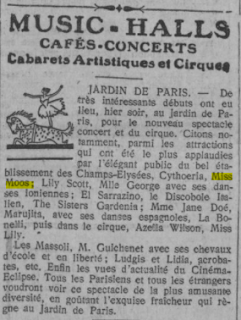

On January 20th, 1911, Zelia quit the revue and left Paris with Dufrenne & Grandjean's company. Beginning January 24th in the city of Troyes, the company of twenty-one actors toured France and Belgium for over 13 months. In August, during a brief rest from the show, she returned to the French capital to perform for a week at the Jardin de Paris. In March 1912, the company briefly staged, "Un Voyage de Noces", a three-act revue written by Jean Casan and starring singer, Jeanne Bloch, as the headliner. However, the following month, the company departed for North Africa for a two month tour of Tunisia and Algeria. In local theatres across the Atlas mountains, "Le Train 8h47" (with full stage sets, military equipment and an actual train car) and a new five-act operetta, "Prostituee" (written by Victor Margueritte) was a success amongst the locals and the French colonials. In June 1912, shortly after returning to France, Georges Grandjean passed away.

By November, Zelia had quit the company and was dancing in a revue, "Alma, Tout le monde descend!" at the Magic City amusement park.

*

Zelia Moss disappears from the limelight all of 1913, possibly appearing in small clubs around the Montmartre. In December 1913, she sailed from France back to Brazil, this time with a two-month contract with Paschoal Segreto with a salary of 2,000 Francs per month. On December 30th, she opened as one of the headliners of Rio de Janeiro's Theatro Palace for three weeks and became a major curiosity and fascination to the public, performing to the sounds of the popular Portuguese composer Luiz Filgueiras and his orchestra.. 

Miss Moss: Has Two Genders

On January 1st, 1914, while strolling along the Avenida Branco, crowds swarmed the African-American entertainer. Brazilians were unaccustomed to Blacks walking freely through major cities, fashionably dressed in the latest Parisian fashions and smoking cigarettes (which was considered a man' pastime in strictly Catholic Brazil). In Brazil (as in the United States), the Black population was usually kept in the background, employed as domestics, cooks, field hands, etc. The few Afro-Brazilian entertainers that had the opportunity to appear in the circus/beer hall scene were usually boxers, Capoeira fighters and comical vaudeville acts. The end of European immigration in 1910 meant the resurfacing of fears among Brazilian elite about the “blackening” of the population. 

Also Zelia's extremely tall stature and strong features caused many to confuse her with being a female impersonator. She eventually fled to the Confeitaria Colombo, an elegant cafe on the Rua Gonçalves Dias, hoping to escape the gawking masses. Unfortunately, the crowds followed her inside, surrounding her table and observing her smoke. Eventually, she asked the crowds to come watch her perform at the Palace before hailing a taxi back to her hotel. The event caused her to make front pages of the Brazilian press the following day.

Sao Paulo (January 1914)

SS Saturno from Uruguay to Rio (Feb.17, 1914)

On January 22nd, Zelia sailed to Sao Paulo, where she opened that evening at the Casino Antarctica, staying on for very successful two-weeks. On February 7, she left for Santos, to appear at the Hotel Lanterna de Genova. The day before she was set to sail back to Rio, one of the hotel employees stole five rings worth 500 Francs, and two wallets, one containing 1,008 Francs from her room. She immediately reported the incident to the hotel owner and the local police. However, she was disappointed to discover that the local police were unwilling to cooperate with the Black cabaret artist. Disappointed, she sailed back to Rio.From Rio, Zelia sailed to Uruguay, where she spent a week performing in Montevideo. She then boarded the SS Saturno back to Rio, arriving on February 17th, hastily moving into room no.6 at the Hotel Rio-de-Janeiro at 25, Rua Visconde de Inhaúma. The following evening, she resumed her engagement at the Theatro Palace. On February 21st, she conducted an interview with the "A Noite" newspaper, recounting her scandalous ordeal in Santos two weeks prior. Once her second engagement with the Palace had ended, she returned to Europe.

"La Petit Dactylo" as Comtesse Papreka

Zelia doesn't resurface until October 1916, appearing in Paris in the three act vaudeville-operetta, "La Petit Dactylo" at the Theatre du Gymnase for a month. Created by Maurice Hennequin & Georges Mitchell, the star of the revue was the 22-year old singer Yvonne Printemps, supported by Henry Defreyn, Harry Baur, Marcelle Rayne and Lucienne Debrennes and Zelia (as the Comtesse de Papreka, with a headress of white feathers) performing to the sound of H. Maurice Jacquet's orchestra.

*

In January 1917, she was a headliner in variety program at the Theatre Le Peletier. Five months later, in May, she was apart of the revue, "La Revue Caressante" at the Theatre Gaite-Rochechouart for two months. The two act revue, set in Napoleonic Egypt, was created by P. Briollet & Alin Monjardin, the headliner was the Spanish vedette, La Belle Manesca supported by Sinoel, Henry Rossi, Marichal, Vylna, Simonne Sym and others. Zelia was given much praise for her sensual and exotic dance number in the tableaux, "Nuit d'Egypt" (Egyptian Nights).

"Judith, Courtisane..." (1917)

On December 22nd, she opened at the Theatre Michel in the comedy operetta, "Judith, courtisane..." with famous dancer Cleo de Merode, comedian Dorville, Renee Baltha, Madeleine de Barbieux as the principal stars. The production (with two acts and three tableaux) was created by Andre Barde & Michel Carre, music was provided by Charles Cuvillier's Orchestra and costumes and décor designed by the coutier, Paul Poiret. The operetta ran for two month, closing on February 15th, 1918.

Sao Paulo (October 1918)

Circo America (November 1918)

She remained in the French capital until the spring of 1918, when a bad love affair with a Frenchman and heavy German bombardment caused her to flee France permanently. Instead of returning to the United States (where she hadn't been in over fifteen years), Zelia returned to Brazil. By September, where she established herself in a house at 9, Rua Visconde de Uruguai in the Cantareira neighborhood of Niterói across Guanabara Bay from Rio de Janeiro, signing a contract with the Empreza Freitas Soares agency before departing for Sao Paulo, where she opened on October 1st, 1918, at the Miramar Cinema, remaining for a week. On November 14th, as WWI drew to a close, Zelia danced in the "Grande Feira Annual", a large festival of entertainment held at the brand new Circo America (located on the remains of the old Ajuda Convent, beside the Theatro Alhambra). Newspapers mentioned Zelia as: “The beautiful North-American, who performs innovative dances”. On the morning of December 1st, 1918, Zelia boarded a ferry across Guanabara Bay back to Niteroi. While strolling through the streets on her way home, she was arrested by a police officer who accused her of being a female impersonator. After appearing before the local judge and a quick medical exam with Dr. Plinio Travassos, the courts quickly dropped the charges.

Fazendo A America (1925)

During the 1920s, as Jazz and Samba began to sweep across Brazil, Zelia wanted to branch away from dancing attempted numerous times to embark on a full Brazilian tour as a professional concert singer, however, the various theatrical booking agents were unable to secure stable employment for the American star. 


Negresse de la Butte (1926)


By 1925, Zelia Moss, having retired from the stage, relocated to Sao Paulo and rented a room at a brothel at 20, Rua Tymbiras (a street that was well-known for brothels and gambling dens). She was soon able to support herself by providing services as a clairvoyant, palm reader, tarot card reader and selling lucky charms. Zelia became extremely successful in Sao Paulo and was soon charging 3,000 reis per consultation. However, she soon caught the attention of Brazil's Delegado de Costumes e Jogo. The function of this government organization was to investigate and prevent all activities of public drunkeness, lewd books, drawings & prints as well as the suppression of African religions such as Umbanda, Macumba and Candomble. Tarot reading had become an extremely lucrative business in 1920s Sao Paulo and the Delegado was determined to squash it.

On April 1st, 1925, agents of the Delegado de Costumes e Jogo raided Zelia's apartment during one of her consultations and escorted her to their offices at Rua 7 de Abril, where she was photographed and questioned by Dr. Mario Bastos Cruz about her origins. She recounted her life story and her nearly twenty years as a entertainer. She spoke of how she discovered the clairvoyant arts and tarot in Paris, when she visited the famous prophet and clairvoyant, Madame de Thebes. She was released shortly afterwards. Ten months later, Zelia returned to her previous occupation as a Tarot reader, operating in tent on the side of the road. This lead to another arrest on February 25, 1926. 

Companhia Negra (August 14, 1926)

In June 1926, 39-year old singer, composer, De Chocolat (Joao Cândido Ferreira) invited Zelia to Rio to be apart of his new theatrical troupe, Companhia Negra de Revistas. De Chocolat had toured France, Spain and Portugal in the early-1920s, and was fascinated with Parisian musichall and Afro-American culture in the Montmartre district. There he experienced Europe's curiosity for the exoticism of Africa. He had also been fascinated with Zelia's American origins, European career and her ability to perform in the French language. During this period, she was frequently billed under the misspelled names of Miss Mon's, Miss Moons, Miss Moons-Murray. Also due to her ability to perform in French, she was also often advertised as being from Barbados, Martinique and Haiti. 


The Companhia Negra de Revista's first revue, "Tudo Preto" (All Black) opened July 31for a month at the Theatro Rialto. Together with De Chocolat's musical compositions, Portuguese choreographer, Jayme Silva's dances, musician Pixinguinha and a company of 30 dark-skinned Afro-Brazilians, the revolutionary company was a huge success. Zelia appeared towards the end of the first act in a sketch, "Charabia Africanos", where she performed an exotic African batuque dance number, reminiscent of her Parisian days.

Working with a all-Black company, Zelia quickly discovered and experienced the discrimination and racism that Afro-Brazilians suffered. The same discrimination that had caused Zelia to escape from the United States had caught up with her in Brazil. Critics criticized the revue as revolting and uncivilized. The administration of the Rialto had also installed "odorless dressing rooms" and frequently fumigated the theatre for cockroaches. 


On September 2nd, a new revue, "Preto e Branco" (Black & White) opened at the Rialto, this time Zelia appeared in the second act, in the 15th sketch, "Martinho e Catharina", performing a romantic French chanson to Martinho (played by Guilherme Flores) and Catharina (played by Rosa Negra). After two weeks, on September 22nd, the company opened at Niteroi's Theatro Colyseu. However, De Chocolat left the company after a dispute with Jayme Silva and formed the short-lived Ba-Ta-Clan Company.

On October 20th, the Companhia Negra de Revista opened a Sao Paulo's Theatro Apollo and Theatro Malfada for two weeks. On November 17th, for a week, the company played in Santos at the Theatro Guarany with a new revue, "Carvão Nacional". While in Sao Paulo, the company hired the 11-year old dancer, Sebastião Bernardes de Souza Prata (later known as Grande Otelo).

From December 3rd, 1926 to January 10th, 1927, the Companhia Negra toured the state of Sao Paulo, appearing in Ribeiro Preto, Bebedouro, Campinas, Piracicaba and Amparo. In the spring, the company returned to Rio, opening a new revue, "Cafe Torrado" at the Theatro Republica on March 5th for two weeks. The company then played four days in Petropolis. In April 1927, the company left for a tour the states of Pernambuco and Bahia, which lasted three months.

The Company received a contract for a tour of Uruguay and Argentina. Unfortuntely, however the Brazilian government threatened the company with imprisonment and deportation if the "Negro-revue" went abroad as it was felt the company didn't properly represent Brazil.

"A Lei do Inquilinato" (1927)

Returning to Rio in July 1927, Zelia took a rest from the company, having secured a role in William Schocair's latest comedy, "A Lei do Inquilinato". Filming took place at the Quinta da Boa and Jardim da Gloria. The film, a Brazilian attempt at emulating American Westerns, premiered August 20th, 1927.

Zelia was soon back with the Companhia Negra and on September 10th, for a week, the company made its final appearance in Rio de Janeiro at the Circo Central Variedades. Afterwards Zelia Moss disappears for over 12 years. During the late-1920s, she doesn't seemed to have recorded while in Brazil as Afro-Brazilians began capitalizing off recording popular numbers from the Companhia Negra. When the Companhia Mulata Brasileira was formed in September 1930, Zelia would've been too dark-skinned to be apart of the cast.


Zelia Moss retired from the stage during the 1930s-1940a, eventually turning to domestic work to support herself. She returned to the limelight in 1941, joining the Companhia Casa de Loucos. In August 1941, the company performed for the first time in the revue, "Praia Vermelha" (Red Beach) at the brand new Theatro Casa de Loucos on the Rua Pedro I. She's briefly mentioned again in a article the following year, but disappears afterwards, most likely returning to domestic work.

Zelia Moss, aged 70, passed away on June 4th, 1952 in Rio de Janeiro. She was later buried at the Cemiterio de Sao Francisco Xavier.

Sunday, October 22, 2017

The Mysterious Dinah Cofie & Her Colored Cracks Orchestra

Dinah Cofie (1900-1959)


The origins of Dinah, the racially ambiguous entertainer, are still a mystery. She was born Madge Khamm around 1900 in Birkenhead, a busy industrial port town across the Mersey river from Liverpool in Cheshire county. She claimed in later interviews to have the product of an African-American father and an English mother. However, currently there aren't any records of her family.


During the summer of 1915, at 15-years old, Madge crossed the river Mersey to Liverpool and began performing in various local theatres and variety halls. The following year she had teamed up with a local comedian, Jack Seymour and she joined him on the British theatrical circuit. In September 1916, on a trip back from Scotland, Madge ran across Charles Harrington's “Uncle Tom's Cabin Company” in Manchester and joined as a singer. In Act 4, Scene 3: The Plantation Festival, she received considerable attention for her song and dance number, where she performed ‘Away Down Tennessee’. She quickly caught the eye of the West African actor John Bessima-Kofie, who played the lead role of Uncle Tom.


Kofie was born John Bessima Boehm-Kofie around 1884, in the British Gold Coast Colony (now Ghana) in the village of Elmina, 45 miles west of the port city of Sekondi-Takoradi. Claiming to be the son of a wealthy Ashanti chief, he was privileged enough to receive an education and by 1901, at age 17, he was studying music. By 1908, Kofie (under the name John Harris Boehm) had migrated to central England, settling in Coventry, where he met 25 year old Louisa Vernon, a clerk at the Empire Theatre. On December 7th, 1908, the couple married. Moving into the home of Louisa's parents at 126 Westwood Road, Kofie began studying to receive his driver's license.

August 1909


Then one day, he stopped coming home. Roaming around England seeking employment, in May 1909, he wound up in London, where he auditioned and received the lead role in the Uncle Tom's Cabin Company. From 1909-1913, Kofie quickly rose to fame as a successful actor, criss-crossing around the British Isles. Earning 35 shillings a week, he frequently sent his estranged wife a stipend of 10 shillings, but never sent for her to join him. On August 24th, 1909 she filed a separation order, however the order was dismissed by December 1912. Although she seems to have carried his surname for the remainder of her life, the marriage was effectively over. 

In May 1913, Kofie began working as the manager of Will Garland's Negro Opera Company. Composed of a mixture of African-American and Afro-British musicians, entertainers and a set of chorus girls known as the Eight London Belles, the company undertook a five month tour across the Russian Empire, beginning on May 15th at Warsaw's Aquarium Theater. Besides managing, Kofie also operated as a pimp, seizing the passports of the chorus girls and pressuring them to sleep with wealthy noblemen after the show. The tour eventually ended, after the women began submitting complaints to the British Embassy. Returning to London, Kofie possibly resumed working with Garland's company in 1915 before joining Harrington's Uncle Tom's Cabin Company that winter.

May 1918


In the summer of 1917, a heavily pregnant Madge left the show and returned home to Birkenhead and on July 24th, she gave birth to Beleika Boehm-Kofie. Six months later, in January 1918, John Kofie had also departed from the company, forming the comedy duo “Kofie & Kam” performing a sketch onstage called, “Her Savage Suitor”, written by John. They were frequently advertised as the funny South African Chief and his Creole assistant. The couple toured extensively across the British Isles until September 24th 1919, when Mr and Mrs J. B. Kofie boarded the RMS Abinsi in Liverpool for a four month trip to his homeland. The purpose of this trip to the Gold Coast is unknown, although it's possible John wanted to introduce his new wife to his family. 


SS Appam Passenger List


In January 1920, a six-month pregnant Madge boarded the SS Appam in Sekondi-Takoradi for the trip back home alone to Birkenhead. John followed her shortly afterwards. On May 26th, Nada May Boehm-Kofie was born and later baptized the following month on June 12th at St. Paul's Catholic Church. Shortly after her birth, the couple began a brief European tour, eventually winding up performing at Milan's Monte Merlo nightclub as members of the Quintetto Mirador with Madge playing alto saxophone and John playing drums.


Settling back in London early 1921, the children were put in the care of a family in the town of Newington (a neighborhood in South London) while her parents continued working. That February, the couple were cast in Laurence Eyre's play “Mis Nell ‘o New Orleans”, which opened February 14th and ran successfully for four months at the Duke of York Theatre before touring Britain. 


Bal Tabarin (mid-1920s)

Eventually the couple made their way to Paris in 1923, appearing in the revue "Luttes Feminine" at the Bal Tabarin with their Darktown Jazzers Orchestra and regularly performing at 9pm on Radio Radiola. Three years later, in 1926, they were frequently seen around the Montmartre and Montparnasse in nightclubs such as the Lido des Champs-Elysées, Harlem Cabaret and the Château Caucasien. While in Paris, John (now performing under the pseudonym of Samuel Cofie) organized a new jazz band, 'Cofie's Colored Cracks', composed of African-American musicians mostly from Harlem and Chicago (The Kofies, Frank Withers, saxophonists Angelo Fernandez, Maxwell Philpott and Wilson Townes, trumpeter Titus D. Triplett, pianist Abram Henderson and banjo player Gilbert Roberts).

In January 1927, the band began a four month Spanish tour, performing at Madrid's Palmero-Alkazar Cabaret, where Madge was listed as the 'Creadora del Black-Bottom' (before the arrival of Ruth Bayton). Afterwards the group played a month at the Kursaal Cabaret in Scheveningen, Holland. Beginning in October, the band arrived in Budapest for a two month engagement at the Parisi Kalitka in the jazz revue "A Neger Jazz Utolso Honapja". Madge's singing & dancing caught on well with the Hungarians and they were engaged for another month at the Royal Orpheum before returning to Paris.


Barcelona International Exposition (1929)

Most of 1928 was spent performing around Paris, particularly at the Café Anglais. That October, the band returned to Spain, moving into the Hotel Meuble and beginning a five month engagement at the Palmero-Alkazar Cabaret. Afterwards, they spent a brief period in Italy, playing places like Bologna's Teatro Medica with acclaimed success. Returning to Spain in May 1929 for the opening of the International Exposition, the group performed on the exhibition grounds in Barcelona's Turo-Park for two months before moving on to Madrid's Ideal-Rosales Cabaret for another two months that summer. This was followed by two months at Barcelona's Miramar Club and three months at the popular Eden Concert Musichall. 

In February 1930, the orchestra departed for Italy once again for an engagement at Rome's Teatro Excelsior before moving north in April for Switzerland for a three month engagement at Zurich's Cafe Esplanade. Afterwards the jazz band disassembled and the Kofies returned to Paris, playing the Music Box nightclub in November.


During the spring of 1931, while performing at Ange Bleu nightclub, Madge Kam-Kofie suddenly reinvented herself. She became the American blues singer, Dinah, her repertoire composed of popular African-American jazz and blues numbers while Sam continued to accompany her on the drums. On July 7th, Dinah departed for Berlin's UFA Studios to appear in the French-German comedy film, “Le Petit Écart” directed by Henri Chomette and Reinhold Schünzel. Like most Black entertainers in Europe at the time, she appeared in a nightclub scene, singing J'ai Tout Quitté Pour Mon Amour. The film was released on October 22nd. 


Returning to her homeland of England in September, she performed for a month at London's Berkeley Hotel. While there, on October 9th, she recorded two songs for Decca Records. The songs, Good For You, Bad For Me and Makin' Faces At The Man In The Moon are the only known recordings she is known to have made. 

Meanwhile, back in Paris, Sam had signed the lease for a new nightclub at 132 Boulevard Montparnasse. The establishment, Chez Dinah, opened October 15th and ran until mid-June 1932. The club rose to become a popular fixture in the Montparnasse. Black entertainers and tourists residing in Paris flocked to the club and mingled. Unfortunately, the Great Depression that was ravaging the United States had reached France and businesses began failing. Strict French laws were also making it difficult for Black entertainers to remain working in France for long periods of time. Throughout the summer of 1932, Dinah began performing in various galas, parties and nightclubs around the French capital such as the Abbaye Thélème and the Cigogne restaurant. However, according to an American gossip column on August 9th, she was unemployed. 

In September, Dinah departed for Germany for a three month engagement at Berlin's short-lived Beguine Bar. The German engagement proved to be successful and upon her return to Paris on December 7th, Sam had opened a new establishment, Cabane en Pigalle at 72 Rue Pigalle, where Dinah was the star of an elaborate floor show titled, “Below The Mason-Dixon Line”. 


However that too failed, and after a month, she departed for Cannes in January 1933, where she appeared at the Dolphin Cabaret. While there, she signed a contract with British director Robert Messulam to appear in the film, Lily of the Laguna. Unfortunately the film never materialized and Dinah returned to Paris where she partnered with Ada Bricktop Smith with plans to open a nightclub together. Unfortunately soon, the two began to feud and quickly grew into rivals. After running another failed Chez Dinah in Biarritz that summer, Dinah returned to Paris that fall, entertaining at the American Women’s Club, Le Pigall’s, Caverne d’Ali Baba, Café Alcazar and the Pot Aux Roses restaurant until May 1934.


Rio de Janeiro (1936)

Possibly influenced by Afro-British bandleader George Stretton (born William Masters in Liverpool 1887), whom Sam met in 1915 as a member of the Will Garland Company, Dinah and Sam Cofie decided to travel to South America.

June 1934


In June 1934, the couple boarded the MS Neptunia in Trieste, Italy and sailed to Buenos Aires. Arriving June 11th, the couple were given a warm welcome from the Argentine press. Nine days later on June 20th, the couple debuted at the Gran Teatro Broadway, where Dinah was billed as the ‘Reina de Harlem’. Their engagement lasted two successful weeks and upon the end of their contract, they signed a contract with Radio Prieto, where they performed throughout the summer while appearing nightly at the popular Boîte Tabú. During this engagement, Sam sent for his friend, African-American bandleader Benny Peyton and his Jazz Kings Orchestra to join the couple in Argentina.

April 1935


Dinah at the Monseigneur Club

In February 1935, the Dinah and her orchestra traveled to the resort town of Mar del Plata for a successful engagement. When they returned to Buenos Aires the following month, Sam was reported as gravely ill and later falsely reported as dead. However, in April, they appeared very much alive at the Boîte Monseigneur and three months later at the Téatro Maipo in the revue, “Okey, ché”. By mid-1935, Benny Peyton and his Orchestra had returned home to Europe. 

In December 1935, the couple departed for Rio de Janeiro for a three-month engagement at the Casino Atlântico’s new roof garden. The large roof garden cabaret overlooked the Atlantic and Copacabana beach and had revolving floors and the walls were decorated with scenes of popular cities around the world. The couple returned home to Buenos Aires aboard the SS Highland Monarch on March 8th, 1936.


On August 8th, Dinah, Sam and musical duo Los Filipinos (Tino Dominguez & Acosta) signed Radio Cultura LR 10, performing nightly between 7:30-9:00pm until April 1937. Dinah frequently appeared in the Radiolandia and Caras y Caretas magazines documenting her radio career.  


Dinah didn't appear again until December 1937, singing at ritzy La Chumiere restaurant with Gordon Stretton and his Harlem Knights Orchestra. Unfortunately she seems to have disappeared from the entertainment business shortly after this engagement.


At some point, Sam Cofie (John Bessima Boehm-Kofie) died and Dinah returned to England to be closer to her daughters. In the 1940s, Dinah married a man named Thomas Evans and relocated to Ghana with her daughters. In 1948, her oldest daughter Beleika (sometimes spelled Baleeka) immigrated to the United States, settling in New York City, where she died on July 13th, 1995. Her daughter, Nada May returned to London in 1950 with her son, Wallid Accad (born 1946 in Accra, Ghana). Nada later died in Shrewsbury on November 3rd, 1975. In 1953, Dinah and her second husband settled in the lush North London neighborhood of Hampstead, where she died six years later in the summer of 1959.